D, X and Y
The D register - Use with indexed addressing modes - Use for conditional jumps - Schematic - Differences between NQSAP and BEAM index registers - Useful links

The 6502 microprocessor features two index registers, X and Y, which can easily be reproduced in a TTL computer; they are independent registers that can be written to and read from as needed.
The D register
The D register of the NQSAP and BEAM is used to support conditional jump instructions and those that perform operations on a memory location that is the result of a computation between the base address specified in the operand and four different ways of interpreting the values assumed by the X and Y index registers:
| Addressing Mode | Acts on the address defined | Mnemonic | Result | Example* |
|---|---|---|---|---|
| Absolute, X | by the sum of the operand and the value in X | LDA ($20, X) | A = value contained in location ($20 + X) | X = #$03; A = value at location $23 |
| Absolute, Y | by the sum of the operand and the value in Y | LDA ($20, Y) | A = value contained in location ($20 + Y) | Y = #$03; A = value at location $23 |
| Indexed Indirect X | at the location pointed to by the sum of the operand and the value in X | LDA ($20, X) | A = value contained in the location pointed to by pointer ($20 + X) | X = #$03; $23 = #$50; A = value at location $50 |
| Indirect Indexed Y | by the sum of the location pointed to by the operand and the value in Y | LDA ($20), Y | A = value contained in the location pointed to by pointer ($20) + Y | Y = #$03; $20 = #$60; A = value at location $63 |
* $23 = #$50 means that hexadecimal address $23 contains hexadecimal value #$50:
- the $ notation refers to an address
- the #$ notation refers to a value
It should be noted that some 6502 addressing modes are redundant in a computer with only 256 bytes of RAM: for clarification see the Addressing Modes section on the ALU page.
Use with indexed addressing modes
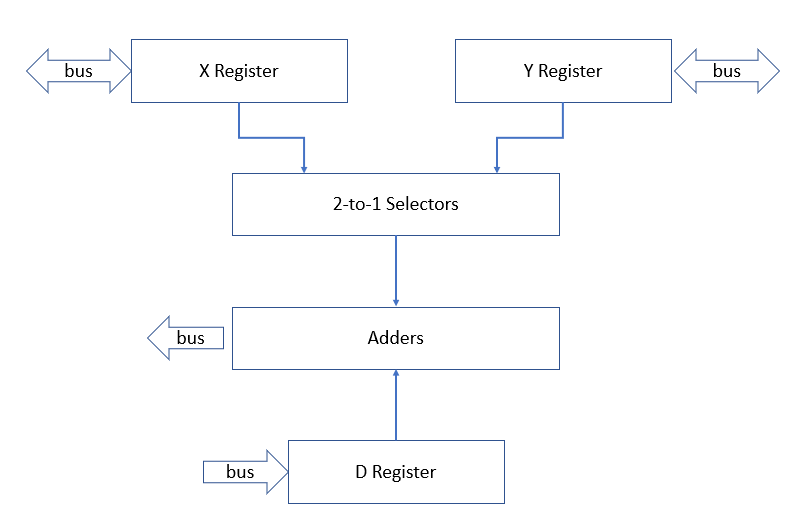
The contents of register D can be added to the contents of registers X, Y, or neither (in this last case, D could be useful as an additional auxiliary register for defining other custom instructions; the use of this mode is not necessary to emulate the original 6502 instructions).
To select whether D should be added to X, Y, or nothing, 74LS157 multiplexers (MUX) are used, driven by signals DY and DZ in the NQSAP and DX/Y and DZ in the BEAM.
To perform the computation, 4-Bit Binary Full Adders With Fast Carry 74LS283 are used, which add whatever is loaded into register D to the value contained in index registers X or Y.
The result of the computation can be exported by activating the RD signal: the Adder outputs will then be exposed on the bus. Note that register D is “Write only”, so it is not possible to directly output its contents onto the bus; however, it is possible to read the value originally present in D by bringing the DZ signal to the HI state, thereby disabling the ‘157 outputs and causing the Adders to perform the operation D + 0 = D.
The logical flow taken from Tom Nisbet’s explanation clarifies the operation:
Use for conditional jumps
A conditional jump is executed if a certain condition is met. In the following example, the BCS instruction is unconditionally executed. The operand value $03 is added to the address of the instruction following the jump instruction, i.e. $03 + $83 = $86, which will be loaded into the Program Counter (PC).
SEC         ; $80 - Set Carry Flag
BCS $03     ; $81 - Jump to $03 + $83 = $86 if Carry is set
INX         ; $83 - This instruction will be skipped
INX         ; $84 - This instruction will be skipped
INX         ; $85 - This instruction will be skipped
LDA #$01    ; $86 - This instruction will be executed
The operand is a signed 8-bit value that can range from -128 to +127, which means that conditional jumps can jump forward by 128 addresses and backward by 127.
To jump to an address preceding the jump instruction, the operand value must be between $80 (-128) and $FF (-1), according to the rules described in the Unsigned and Signed Numbers section of the Binary Arithmetic page (if I add 0x01 to the largest address 0xFF, I return to address 0x00).
LDX #$05    ; $80 - Load register X with 5
DEX         ; $82 - Decrement X
BNE $FD     ; $83 - Jump to $85 + $FD = $85 - $03 = $82 if X is not zero
RTS         ; $85 - Return from subroutine
Since the configuration used for the ‘283 Adders only allows additions to be performed, one might wonder how it is possible to execute a backward jump. In the NQSAP, as in the BEAM, registers are 8 bits wide: a simple shortcut to achieve the desired result is to add the operand to the PC treating both address and operand as unsigned numbers: in this specific case, $85 + $FD = $182. The 9th bit (corresponding to the Carry) is not taken into account and the remaining $82 will be loaded into the PC.
This technique works correctly thanks to the cyclic nature of memory addressing in an 8-bit system.
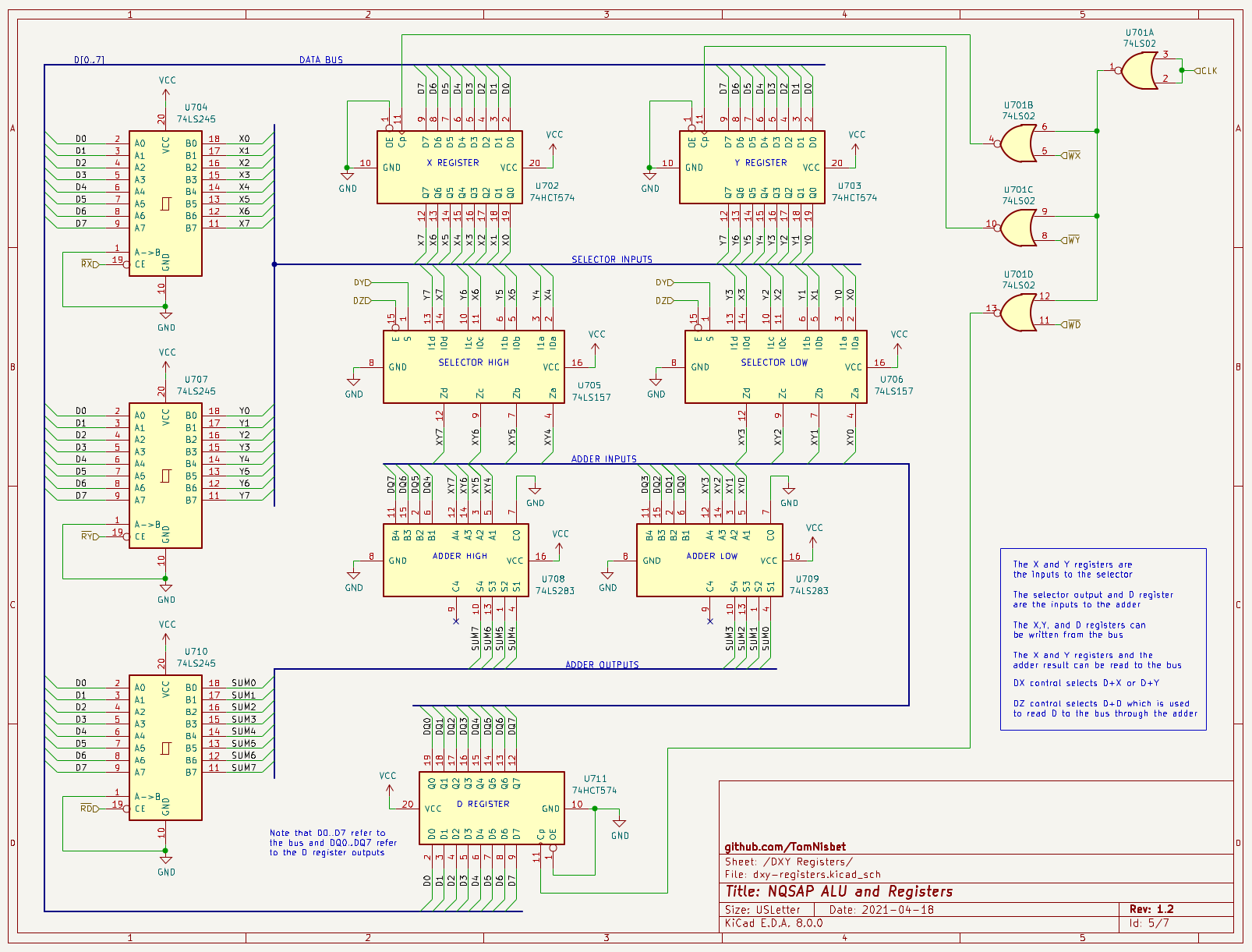
Schematic of the NQSAP index registers.
Schematic
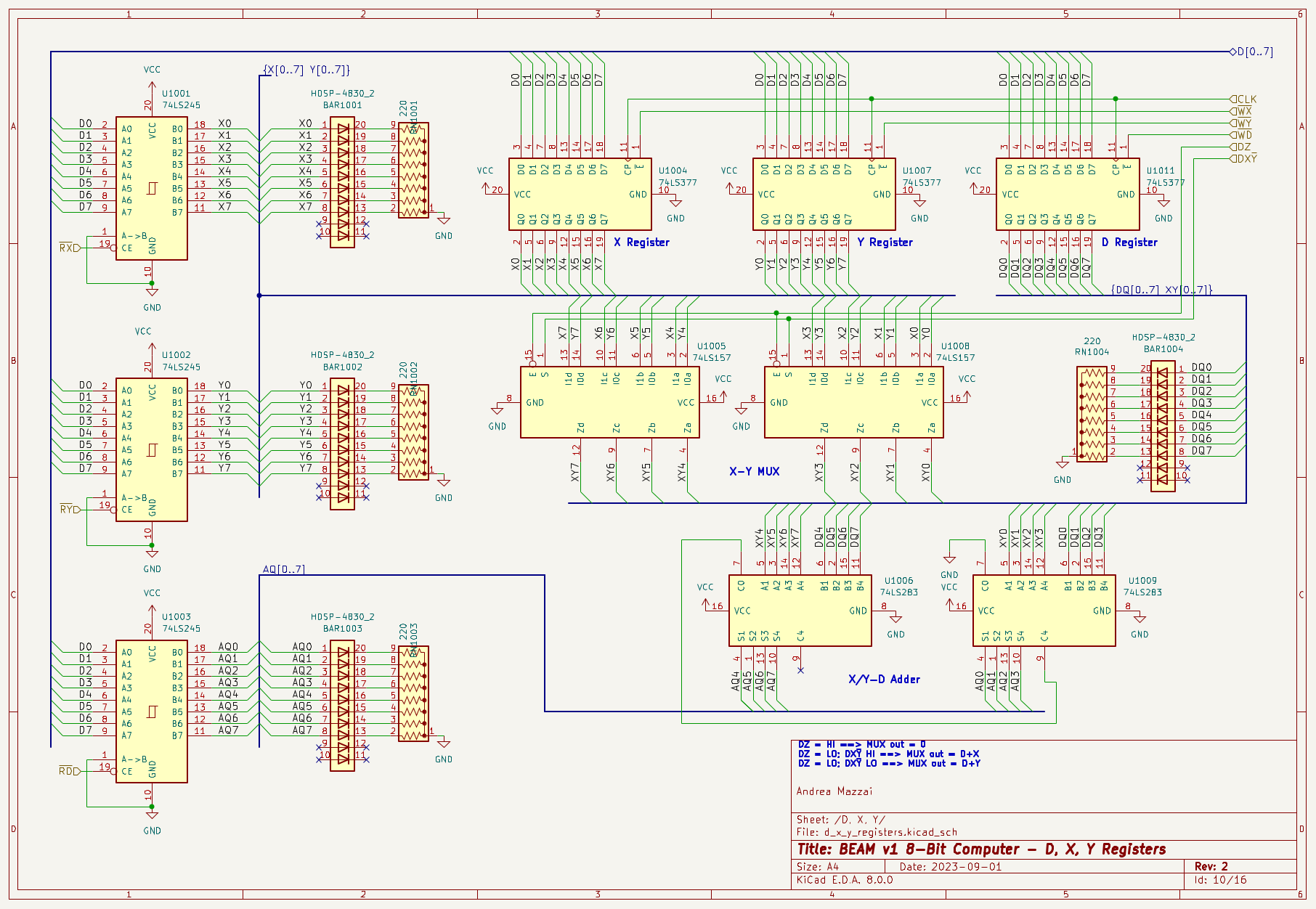
Schematic of the BEAM computer index registers.
Differences between NQSAP and BEAM index registers
From a functional standpoint, the schematics of the NQSAP and BEAM index registers are identical.
In my notes I had written that “… as with the other BEAM registers, here too I use 74LS377 D-type registers instead of the Octal D-Type Flip-Flop with 3-State Outputs 74LS574 used by Tom in the NQSAP”; see the section The NQSAP ALU for clarification on this point.
For completeness, I should mention that I became acquainted with the 74LS377 while studying the NQSAP-PCB, an evolution of the NQSAP that Tom had subsequently engineered on PCB rather than on breadboard.
Useful links
- Tom Nisbet’s NQSAP DXY registers.